
Estimated Read Time: 18 minutes | Last Updated: 2026-01-01 | Target Audience: Beginners & Career Changers
🎯 Key Takeaways
- No degree required: 90% of graphic designers work freelance; portfolio matters more than credentials
- Income potential: US designers earn $50.7k–$110k+ depending on specialization (UX/UI highest-paid)
- Essential skills: Master design principles + Adobe Creative Suite (or free alternatives like GIMP)
- Timeline: 6–12 months to build job-ready skills with consistent practice
- 2026 trends: AI integration, motion graphics, and sustainable design dominate demand
What Is Graphic Design?
Graphic design is the art of using visuals images, colors, typography, and layout to communicate specific messages, tell stories, and solve problems for businesses and individuals. Unlike traditional art created for personal expression, graphic design serves a commercial purpose: guiding perception, influencing decisions, and enhancing user experience across print and digital media.
From logos and websites to packaging and advertising, graphic designers blend creativity with technical skills to arrange elements effectively. The field spans multiple specializations including branding, UI/UX design, motion graphics, and environmental design.
💡 What Others Miss: Graphic design isn’t just about making things look pretty it’s strategic visual problem-solving. The best designers understand user psychology, accessibility standards, and how visual hierarchy influences behavior.
Core Elements of Graphic Design
- Color: Evokes emotion; 62–90% of consumer decisions influenced by color alone [1]
| Design Category | Primary Focus | Common Applications |
|---|---|---|
| Visual Identity/Branding | Brand consistency | Logos, color palettes, style guides |
| UI/UX Design | User experience | Apps, websites, interface layouts |
| Motion Graphics | Animation & storytelling | Explainer videos, animated logos |
| Print Design | Tangible materials | Brochures, packaging, posters |
| Environmental Design | Physical spaces | Signage, wayfinding, murals |
Essential Skills & Design Principles
Mastering graphic design requires both creative intuition and technical knowledge. The 8 fundamental principles guide every professional project:
The 8 Core Design Principles
- Balance: Distributes visual weight evenly (symmetrical or asymmetrical) to create stability
- Contrast: Uses differences in color, size, or texture to make elements stand out
- Alignment: Organizes elements to create clear connections and visual flow
- Repetition: Reinforces brand identity through consistent fonts, colors, shapes
- Proximity: Groups related items together for clarity
- Emphasis: Draws attention to focal points through size, color, placement
- White Space: Negative space improves legibility and focus
- Hierarchy: Guides viewers through content using visual weight
Technical Skills Required
According to Zippia’s analysis of 507,690 global graphic designers, the most in-demand technical skills are:
- Software proficiency: Adobe Creative Suite (Photoshop, Illustrator, InDesign), Figma, Sketch
- Typography mastery: Font pairing, kerning, leading, hierarchy
- Color theory: Understanding RGB/CMYK, complementary palettes, psychological impact
- Layout & composition: Rule of thirds, golden ratio, grid systems
- Web fundamentals: Basic HTML/CSS knowledge (for UI/UX roles)
- Motion design: After Effects, Premiere Pro for animation
⚡ Pro Tip: Don’t try learning 4–6 programs simultaneously. Start with one raster-based tool (Photoshop) and one vector tool (Illustrator). Once comfortable, expand to specialized software based on your chosen niche.
Soft Skills That Set You Apart
While technical skills get you hired, soft skills determine long-term success:
- Communication: Presenting design rationale, understanding client needs
- Problem-solving: Creative solutions under constraints
- Time management: 54% of designers change jobs within 2 years meeting deadlines builds reputation
- Feedback reception: Separating personal attachment from professional critique
- Business acumen: Pricing, contracts, negotiation (especially for freelancers)
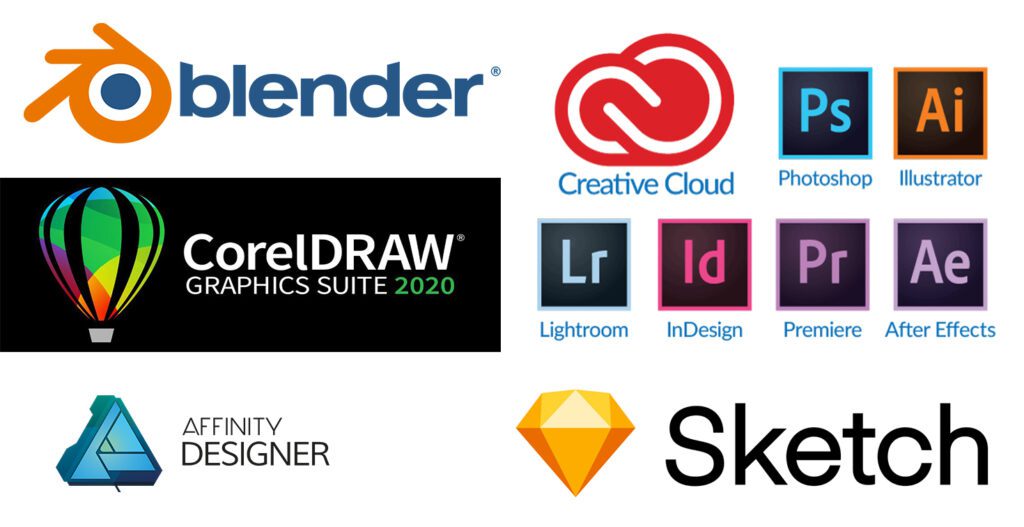
Best Tools & Software for 2026
The graphic design software market is dominated by Adobe, holding 43.8% market share (Photoshop alone), followed by Illustrator (14.5%) and InDesign (28.7%). However, budget-friendly and free alternatives exist for every skill level.
Industry-Standard Paid Tools
| Software | Best For | Key Strength | Approx. Cost |
|---|---|---|---|
| Adobe Photoshop | Photo editing, compositing | Raster-based precision | $54.99/mo (full suite) |
| Adobe Illustrator | Logos, vector art | Scalable graphics | Included in CC |
| Figma | UI/UX, collaboration | Real-time team editing | $12/mo (Pro) |
| Sketch | Mac-only UI design | Lightweight interface | $99/year |
| Affinity Designer | Illustrator alternative | One-time purchase | $69.99 (lifetime) |
Best Free Alternatives
Budget-conscious beginners can build professional skills without Adobe’s subscription fees:
- GIMP: Open-source Photoshop alternative with layering, filters, retouching
- Inkscape: Vector graphics editor (Illustrator replacement)
- Canva: User-friendly drag-and-drop for social media graphics (limited free plan)
- Krita: Digital illustration and animation focused
- Gravit Designer: Browser-based vector design
- Photopea: Online Photoshop clone with PSD compatibility
💰 Budget Strategy: Start with free tools to build foundational skills. Once you land paid projects, invest in Adobe Creative Cloud using client revenue. Many universities offer free CC access check eligibility even as a part-time student.
Hardware Requirements
Your laptop choice significantly impacts workflow efficiency. Key specifications for graphic design work:
| Component | Minimum | Recommended |
|---|---|---|
| Processor | Intel Core i5 / Ryzen 5 | Intel i7/i9 / Ryzen 7/9 / Apple M1+ |
| RAM | 8GB | 16GB+ (32GB for video/3D) |
| Storage | 256GB SSD | 512GB+ SSD |
| Display | Full HD (1920×1080) | 4K, 100% sRGB color accuracy |
| GPU | Integrated graphics | Dedicated NVIDIA/AMD (2GB+ VRAM) |
Top laptop recommendations: MacBook Pro M4 (premium), Dell XPS 16 (Windows), MacBook Air M2 (budget), HP Pavilion 15 (entry-level)
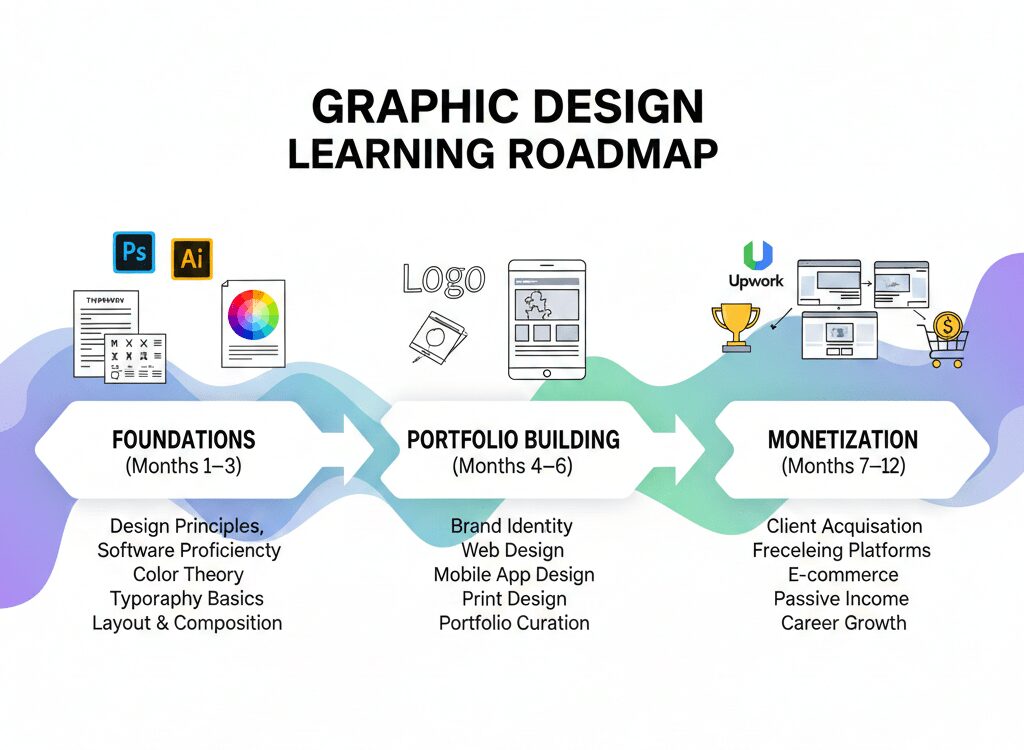
Step-by-Step Learning Pathway
Unlike many professions, graphic design doesn’t mandate formal degrees 68% of US designers hold Bachelor’s degrees, but portfolios outweigh credentials. Here’s a practical 6–12 month roadmap:
Phase 1: Foundations (Months 1–3)
Goal: Understand design theory + basic tool proficiency
- Week 1–2: Study 8 design principles (balance, contrast, etc.) using free resources like YouTube (channels: Will Paterson, Satori Graphics, The Futur)
- Week 3–4: Color theory + typography basics via Canva Design School
- Week 5–8: Master one raster tool (Photoshop or GIMP) through project-based learning
- Week 9–12: Learn vector design (Illustrator or Inkscape) while creating 3–5 logo concepts
Milestone: Complete 10 practice projects (posters, social media graphics, simple logos)
Phase 2: Portfolio Building (Months 4–6)
Goal: Create 6–8 professional-grade portfolio pieces
- Project Types: Brand identity (logo + style guide), packaging design, web mockup, motion graphic (15–30 sec), editorial layout
- Strategy: Use fake briefs from BriefBox or Brief Club to simulate real client work
- Volunteer: Offer free services to 2–3 local nonprofits/small businesses for testimonials
- Study competitors: Analyze Behance/Dribbble top projects in your niche
Milestone: Launch portfolio website on Behance + personal domain
Phase 3: Monetization (Months 7–12)
Goal: Land first 5 paid clients
- Platforms: Start with Fiverr/Upwork for quick wins (accept lower rates initially for reviews)
- Networking: Announce services on LinkedIn, Instagram; join design communities
- Cold outreach: Contact 10 local businesses per week with personalized portfolio samples
- Specialize: Choose 1–2 niches (e.g., restaurant branding, SaaS web design) to stand out
Milestone: Earn first $1,000 from design work
Best Free Learning Resources
| Platform | Best For | Certificate Available |
|---|---|---|
| Coursera (CalArts) | Comprehensive theory + history | Yes (paid) |
| Adobe Express Tutorials | Software-specific skills | No |
| Great Learning (Photoshop) | Beginner-friendly intro | Yes (free) |
| Canva Design School | Quick social media graphics | Yes (free) |
| FreeCodeCamp (Figma) | UI/UX fundamentals | No |
⚠️ Common Mistake: Avoid “tutorial hell” spending months watching videos without creating. Apply each lesson immediately through a mini-project. Learning by doing beats passive consumption.

Building Your Portfolio
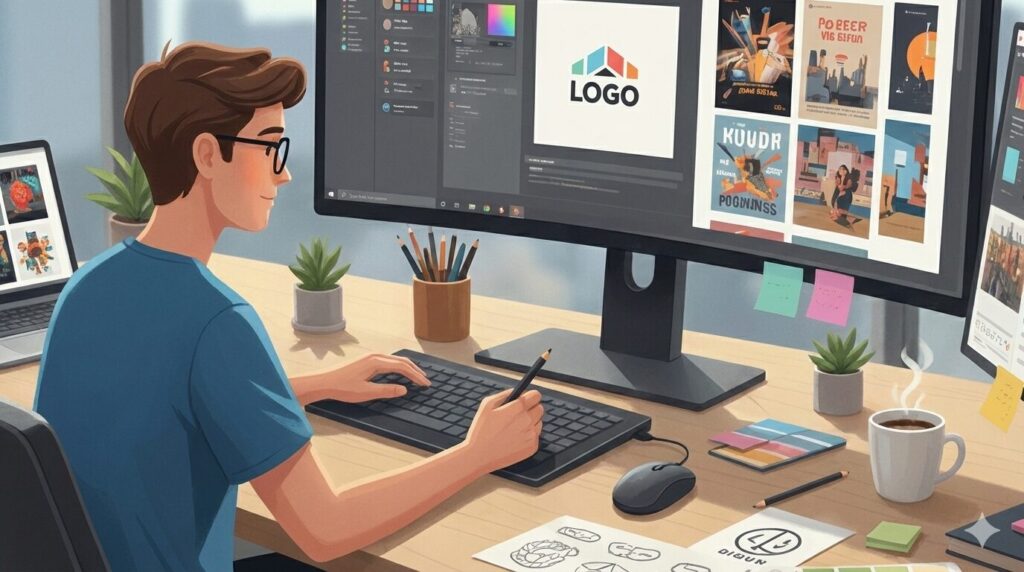
Your portfolio is your currency in design 90% of hiring decisions stem from portfolio quality, not credentials. A strategic portfolio showcases problem-solving, not just aesthetics.
What to Include (6–8 Projects Maximum)
Quality over quantity curate diverse projects that demonstrate range:
- Brand identity: Complete system (logo, color palette, typography, mockups)
- Digital design: Website or app interface with user flow explanation
- Print collateral: Brochure, poster, or packaging design
- Motion graphics: 30-second animation or explainer video
- Typography project: Custom lettering or type-focused poster
- Passion project: Personal work showing unique style
📋 Portfolio Case Study Template
For each project, include:
- Challenge: What problem did the client face?
- Process: Research, sketches, iterations (show behind-the-scenes)
- Solution: Final designs with rationale
- Results: Metrics if available (e.g., “Increased engagement 40%”)
Best Portfolio Platforms
| Platform | Best For | Cost |
|---|---|---|
| Behance | Community exposure, Adobe integration | Free |
| Dribbble | UI/UX designers, “shots” format | Free (basic) |
| Adobe Portfolio | Clean templates, CC subscribers | Free w/ CC |
| Wix / Squarespace | Custom domains, advanced features | $16–$27/mo |
| Crevado | Quick setup, mobile-optimized | Free |
Portfolio Optimization Checklist
- ✅ Mobile-responsive design (60% of traffic is mobile)
- ✅ Fast loading (<3 seconds) compress images
- ✅ Clear navigation with project categories
- ✅ About page with professional photo + brief bio
- ✅ Contact form with clear CTA (“Let’s work together”)
- ✅ SEO optimization (meta descriptions, alt text)
- ✅ Testimonials from clients (even unpaid projects)
💡 Expert Insight: Remove projects as you improve. Your portfolio should evolve what impressed you 6 months ago may dilute quality now. Regular audits maintain competitiveness.
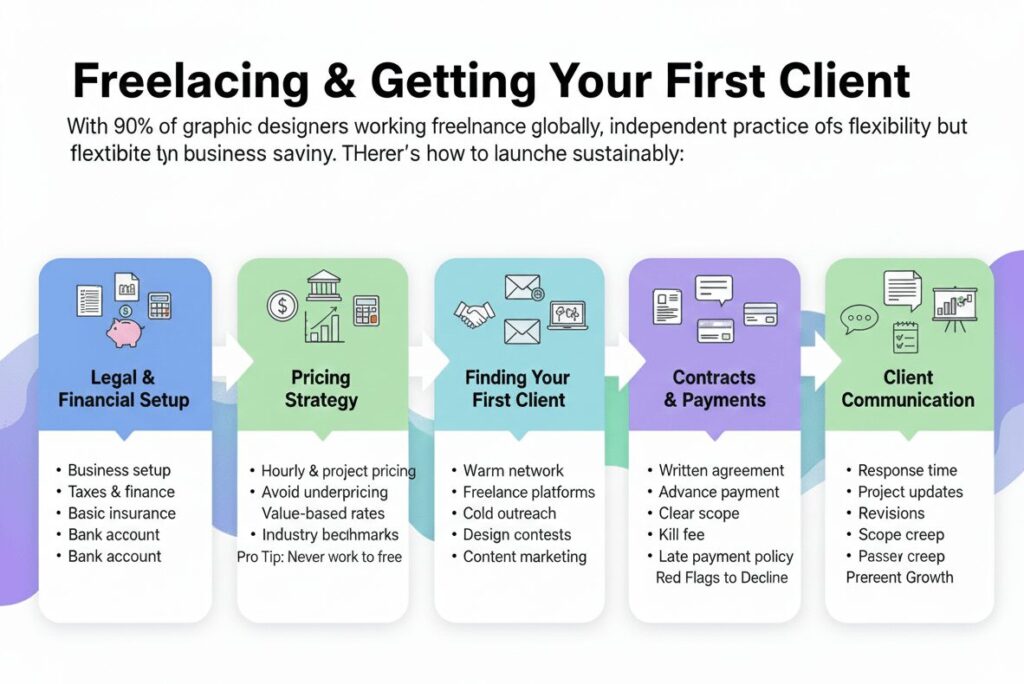
Freelancing & Getting Your First Client
With 90% of graphic designers working freelance globally, independent practice offers flexibility but requires business savvy. Here’s how to launch sustainably:
Step 1: Legal & Financial Setup
Before accepting paid work:
- Register your business: Sole proprietorship (easiest) or LLC (more protection)
- Get a Tax ID (EIN): Required for US freelancers earning $600+
- Open business bank account: Separate finances from personal spending
- Choose accounting software: QuickBooks Self-Employed or Wave (free)
- Set aside 25–30% for taxes: Quarterly estimated payments prevent surprises
- Consider insurance: General liability protects against client disputes
Step 2: Pricing Strategy
The #1 beginner mistake is underpricing. Calculate your minimum viable rate:
💵 Hourly Rate Formula
(Annual Salary Goal + Expenses) ÷ Billable Hours = Hourly Rate
Example: ($50,000 + $10,000) ÷ 1,200 hours = $50/hour minimum
Industry benchmarks (US):
| Experience Level | Hourly Rate | Logo Design |
|---|---|---|
| Junior (0–2 years) | $25–$50/hr | $300–$800 |
| Mid-Level (3–5 years) | $50–$100/hr | $800–$2,500 |
| Senior (5+ years) | $100–$200/hr | $2,500–$10,000+ |
⚡ Pro Tip: Never work for free unless it’s strategic (high-profile nonprofits for portfolio). “Exposure” doesn’t pay bills spec work devalues the industry.
Step 3: Finding Your First Client
5 proven methods:
- Warm network: Announce services on LinkedIn/Instagram. Ask friends/family for referrals. Conversion rate: 20–30%
- Freelance platforms: Upwork, Fiverr, Freelancer.com. Start with lower rates to build reviews. Avg. first job: 7–14 days
- Cold outreach: Email 10 local businesses daily with specific portfolio samples relevant to their industry. Response rate: 2–5%
- Design contests: 99designs, DesignCrowd (competitive but builds visibility)
- Content marketing: Post design tips on YouTube/Instagram to attract inbound leads. Long-term strategy
Essential Contracts & Policies
Protect yourself legally before starting any project:
- Design contract: Scope, deliverables, revisions (limit to 2–3 rounds), timeline, payment terms
- Payment structure: 50% upfront, 50% on completion (or 33% deposit, 33% midway, 34% final)
- Payment terms: Net 14 days (faster than industry standard Net 30)
- Kill fee: 25–50% if client cancels mid-project
- Copyright clause: You retain rights until final payment received
- Late payment policy: 5% interest monthly after due date
🚨 Red Flags to Decline: Clients requesting “just a quick mockup first,” refusing contracts, vague briefs, unrealistic deadlines, or asking for all concepts upfront. Trust your gut bad clients cost more than they pay.
Client Communication Best Practices
- Response time: Reply within 24 hours (sets professional tone)
- Project updates: Weekly check-ins for long projects
- Revisions: Ask “What specific element isn’t working?” vs. accepting “I don’t like it”
- Scope creep: Document all changes; charge extra for work beyond original contract
- Presentation: Explain design decisions (why color choice, font hierarchy) to justify value
Salary Expectations & Market Data
Graphic design salaries vary dramatically by location, specialization, and employment type. Here’s 2025-2026 data to set realistic expectations:
Average Salaries by Country
| Country | Average Annual Salary | Notes |
|---|---|---|
| United States | $50,710–$71,391 | Higher in NYC, DC, CA |
| United Kingdom | £29,237–£29,611 | London premium +15–20% |
| Canada | CA$47,520–CA$51,162 | Vancouver, Toronto highest |
| Australia | A$65,000 | Strong creative industry |
| India | ₹3–8 LPA (entry) / ₹15–30 LPA (senior) | Bangalore pays most |
| Germany | €27,000 | Lower than UK/US average |
Highest-Paying Specializations
Specialization dramatically impacts earning potential. The top 5 lucrative niches:
| Specialization | US Average Salary | Why It Pays More |
|---|---|---|
| UX/UI Design | $98,795–$110,392 | Strategic + tech skills; directly impacts revenue |
| Product Design | $108,906 | Combines UX + visual + prototyping |
| Game Design | $75,080–$118,445 | Specialized skills; booming industry |
| Motion Graphics | $68,392–$94,567 | High demand for video content |
| Brand Identity | $71,417–$90,304 | Strategic positioning; senior roles |
📊 Facts & Figures: The global graphic design market reached $43.4 billion in 2025, growing a continue 3.7% year-over-year. Demand for specialized digital skills (UI/UX, motion) is projected to grow 35% by 2026, while traditional print design faces 22% decline [Sources: IBISWorld 2025, U.S. Bureau of Labor Statistics, PwC Global E&M Outlook, LinkedIn Economic Graph]
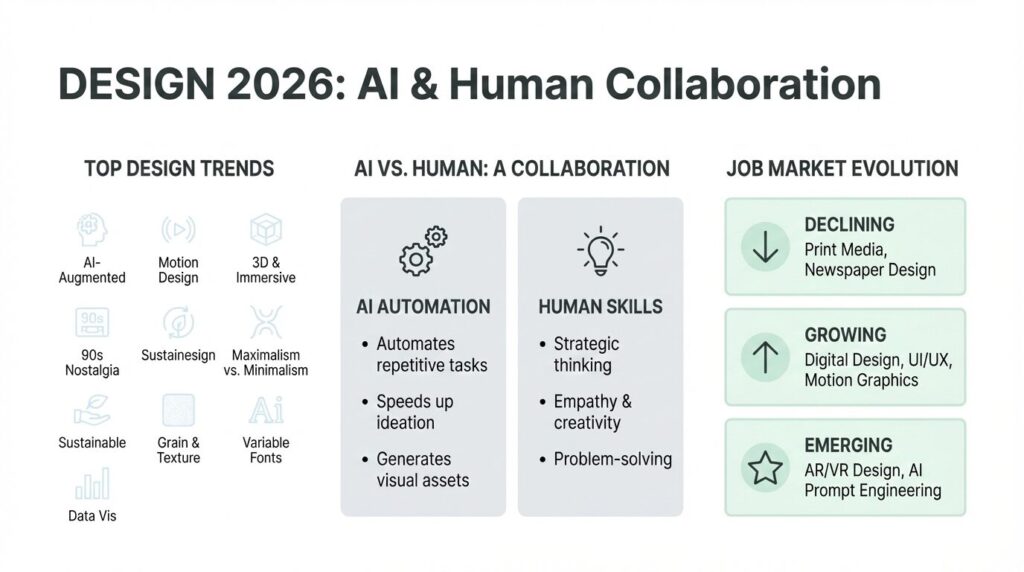
2026 Design Trends & Future Outlook
Staying current with trends ensures portfolio relevance and client appeal. Here are the dominant visual movements shaping 2026:
Top 10 Graphic Design Trends (2026)
- AI-Augmented Design: Tools like Midjourney, Adobe Firefly integrated into workflows for rapid ideation; designers focus on curation + refinement
- 90s Nostalgia: Bold typography, vibrant gradients, and retro color palettes (think MTV aesthetics)
- Motion Everything: Animated logos, kinetic typography static designs feel outdated
- Maximalism vs. Minimalism: Polarized styles either chaotic layering or ultra-clean “brutalist” simplicity
- 3D & Immersive Design: WebGL, Blender renders for depth; AR filters for Instagram/Snapchat
- Sustainable Branding: Earthy palettes, eco-conscious messaging, minimalist packaging
- Variable Fonts: Single font files with infinite style variations (saves load time)
- Inclusive Design: Accessibility-first color contrast, readable fonts, diverse representation
- Grain & Texture: Digital “imperfections” adding warmth to sterile screens
- Data Visualization: Infographics evolving into interactive dashboards
🤖 AI’s Real Impact on Designers
The Truth: AI won’t replace designers it’ll eliminate low-skill tasks. Junior roles doing basic photo editing face pressure, but strategic roles (brand strategy, UX research) remain human-dominated.
Adaptation Strategy: Master AI tools as assistants (Midjourney for moodboards, ChatGPT for copywriting), but differentiate through problem-solving, client empathy, and conceptual thinking machines can’t replicate.
Job Market Outlook (2024–2034)
US Bureau of Labor Statistics projects modest 2–3% growth slower than average but not dire:
- Declining: Print media, newspaper design (-22% projected)
- Growing: Digital/web design (+35%), motion graphics (+40%), UX/UI roles
- Stable: Branding, freelance services, agency work
- Emerging: AR/VR design, NFT art, AI prompt engineering
Key takeaway: Specialize in digital-first skills. General “I do everything” designers face commoditization; niche experts command premium rates.
Frequently Asked Questions
How long does it take to become a graphic designer?
With consistent daily practice (2–3 hours), most beginners reach job-ready competency in 6–12 months. Formal degrees take 4 years but aren’t required 68% of designers have them, yet portfolios matter more for hiring decisions.
Can I become a graphic designer without a degree?
Absolutely. 90% of graphic designers work freelance, where portfolio quality trumps credentials. Free platforms like Coursera, Canva Design School, and YouTube offer professional-level training. Focus on building 6–8 strong portfolio pieces through personal projects or volunteer work.
Is graphic design a dying career?
No but it’s evolving. Print design roles decline 22%, while digital specializations (UI/UX, motion graphics) grow 35%+. AI automates repetitive tasks but can’t replace strategic thinking, brand empathy, or conceptual creativity. Designers who adapt thrive; those resisting change struggle.
Which software should I learn first?
Start with one raster tool (Photoshop or GIMP) for photo editing, then one vector tool (Illustrator or Inkscape) for logos/graphics. Once comfortable (3–4 months), add specialty software based on your niche: Figma for UI/UX, After Effects for motion, InDesign for layouts.
How much should I charge as a beginner?
US rates: $25–$50/hour or $300–$800 per logo for 0–2 years experience. Avoid pricing below $25/hour it signals low quality and attracts problem clients. Use project-based pricing after 6 months to capture value vs. time spent.
What’s the best laptop for graphic design on a budget?
Best value: MacBook Air M2 ($999) for Mac users; HP Pavilion 15 or Lenovo IdeaPad 5 Pro ($600–$800) for Windows. Minimum specs: 16GB RAM, 512GB SSD, Full HD display with good sRGB coverage. Prioritize processor and RAM over GPU unless doing 3D/video work.
Where do graphic designers find remote work?
Top platforms: Upwork (vetted clients), Fiverr (quick gigs), Dribbble/Behance (high-end clients), We Work Remotely, and Remote.co. Over 60% of designers work remotely at least part-time as of 2025, with average remote salaries around $71,391.
Can ChatGPT or AI do graphic design?
AI tools like Midjourney generate images but lack strategic thinking, brand understanding, and client communication. Think of AI as a junior assistant great for mockups and ideation, but designers still direct, refine, and present concepts. The future belongs to designers who leverage AI, not fear it.
What’s the difference between a graphic designer and graphic artist?
Graphic designers solve commercial problems (logos, ads, UI) using strategic layouts and client-focused work. Graphic artists create expressive visuals (illustrations, concept art) prioritizing personal style over function. Designers average $64k/year; artists $57k but roles often overlap.
How do I find my first graphic design client?
5 methods:
1) Announce on LinkedIn/Instagram to warm network (20–30% conversion).
2) Start on Fiverr/Upwork with competitive pricing.
3) Cold email 10 local businesses daily.
4) Volunteer for nonprofits for testimonials.
5) Post free design tips on social media to attract inbound leads
Additional Resources
- Books: “The Non-Designer’s Design Book” (Robin Williams), “Thinking with Type” (Ellen Lupton)
- YouTube Channels: The Futur (business), Will Paterson (logos), Dansky (tutorials)
- Communities: r/graphic_design (Reddit), Designer Hangout (Slack), AIGA (professional org)